What Value LTAD 2.0 Brings to the Table
Six reasons enterprises use LTAD 2.0 before making critical Data & AI commitments
Cost Reduction
Avoid paying for unused platform features
Wider Visibility
See tools beyond analyst shortlists
Faster Discovery
Shorter evaluation cycles with curated insights
ROI Potential
Right-fit tools deliver more value per dollar
See Beyond the Obvious
Access high-quality Data & AI tools that never appear in analyst reports or vendor shortlists.
Decide with Confidence
Make choices backed by full market awareness, not partial visibility or vendor familiarity.
Reduce Cost & Risk
Avoid overpaying for bloated platforms and reduce long-term vendor lock-in.
Faster Time to Value
Skip months of discovery. Start with curated, right-fit solutions from day one.
Stay Flexible
Preserve architectural freedom by knowing your options before commitments are made.
Neutral & Trustworthy
Independent, practitioner-led insights, not influenced by vendor sponsorship or marketing.
Problem Statement
Partial Visibility Leads to Predictable Mistakes
The Visibility Problem Enterprises Rarely Acknowledge
Enterprises do not lack access to Data & AI tools.
They lack visibility into the full market.
In practice, most organizations evaluate only a narrow subset of vendors, typically those already visible through analyst reports, existing vendor relationships, or internal familiarity. This creates a structural bias in how Data & AI decisions are made.
As a result, many high-quality, enterprise-ready tools never enter evaluation, not because they are weak, but because they are invisible at the point decisions are formed.
How LTAD 2.0 Enriches Gartner, Forrester & Other Market Surveys
The yellow and green dots represent niche, high-quality products made visible by LTAD 2.0, tools that traditional analyst frameworks rarely surface.
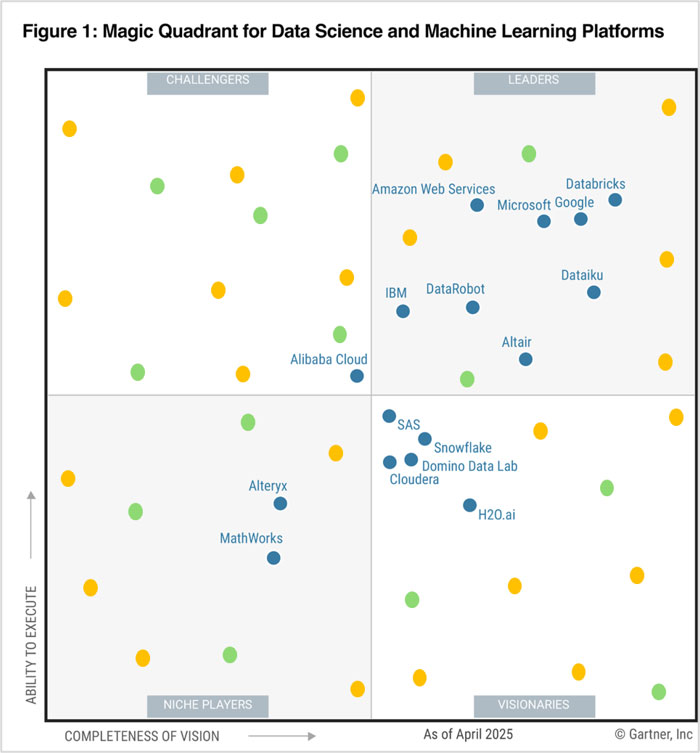
Gartner Magic Quadrant: Data Science & ML Platforms (April 2025)
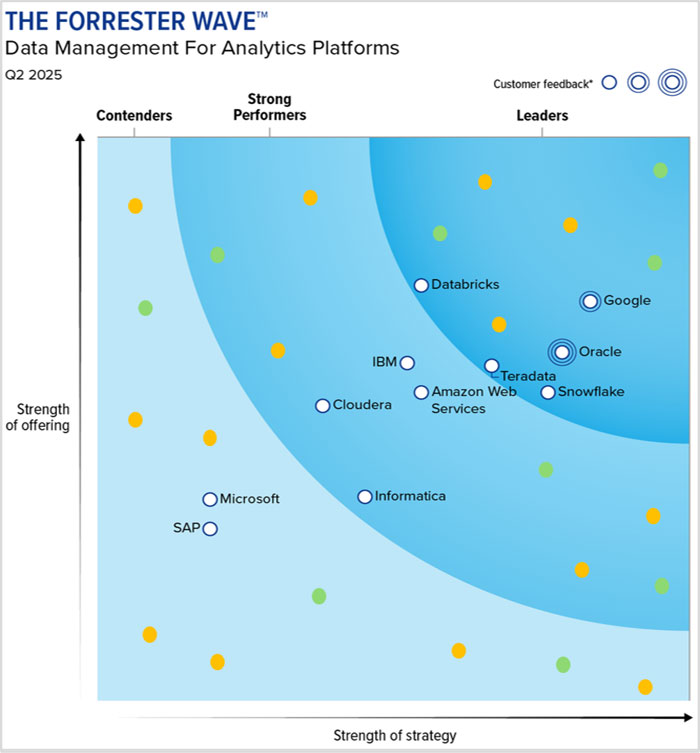
Forrester Wave: Data Management for Analytics (Q2 2025)
Gartner & Forrester apply strict eligibility criteria. Vendors often need:
- •Enterprise implementations across multiple geographies
- •Revenue thresholds and funding stability
- •Broad feature sets, not just single capabilities
This means startups and smaller vendors rarely qualify, even if they excel at solving a real business problem.
The green and yellow dots on these charts represent companies that:
- •Don't meet Gartner or Forrester eligibility criteria (scale, revenue, breadth)
- •Are often single-feature specialists that solve problems faster and cheaper
- •Stay invisible to enterprise buyers despite being enterprise-ready
We extend the horizon by making these hidden players visible:
- •Connecting niche, high-quality startups and SME vendors
- •Pre-vetting for enterprise readiness
- •Bringing them directly to enterprise buyers for evaluation
Smaller vendors with laser-focused solutions could solve the pain point at a fraction of the cost.
The Consequence
Customers default to "Leaders" and pay for large, complex platforms. On average, only 30–40% of features are ever used, but enterprises pay for 100%.
Meanwhile, smaller vendors with laser-focused solutions could solve the pain point at a fraction of the cost, but never make it onto the radar.
Why This Happens
Industry analyst frameworks such as Gartner and Forrester play an important role in enterprise decision-making, but they operate under strict eligibility criteria.
Vendors typically need to demonstrate:
This model works well for identifying established platforms.
It does not work well for surfacing specialized, fast-moving, single-capability tools, even when those tools solve real business problems more efficiently.
The Resulting Pattern
This is not a failure of due diligence.
It is a visibility constraint baked into the system.
And when visibility is constrained, outcomes become predictable.
The Consequence
Cost, Lock-In, and Regret
What Happens When the Visibility Gap Goes Unaddressed
When enterprises make Data & AI decisions with partial market visibility, the consequences are rarely immediate, but they compound over time.
What begins as a "safe" choice often becomes a long-term constraint.
The Predictable Outcomes
Overbuying Complex Platforms
Organizations default to large, all-in-one platforms to "cover all bases." In reality, only 30–40% of features are ever used, yet enterprises pay for 100%, year after year.
Vendor Lock-In
Multi-year contracts and proprietary architectures reduce flexibility. Changing direction later becomes expensive, slow, and politically difficult, even when better options emerge.
Growing Technical Debt
Misfit tools lead to workarounds, manual processes, and brittle integrations. Complexity increases, while agility decreases.
Innovation Lag
While competitors adopt specialized, right-fit tools and move faster, organizations locked into heavyweight platforms struggle to adapt.
Higher Total Cost of Ownership
Licensing, integration, customization, and ongoing maintenance costs quietly exceed initial projections, without proportional business value.
These outcomes are rarely caused by poor intent or lack of expertise.
They are the result of decisions made without full visibility into the market.
Once those decisions are locked in, reversing them becomes far more costly than making them correctly in the first place.
The Solution
LTAD 2.0: What We Do Differently
Extending the Enterprise Horizon
LTAD 2.0 exists to solve a very specific problem:
Enterprises make long-term Data & AI commitments while seeing only a fraction of the available market.
LTAD 2.0 extends that horizon.
Instead of relying solely on analyst shortlists, incumbent vendors, or internal familiarity, LTAD 2.0 provides structured visibility into niche, high-quality Data & AI tools that are typically invisible at the point where decisions are shaped.
These tools are not experimental curiosities.
They are often single-capability specialists, built to solve focused problems faster, with less complexity, and at a lower long-term cost.
What Makes LTAD 2.0 Different
It functions as a strategic visibility and decision layer, designed to support enterprises before they commit to platforms, architectures, or long-term contracts.
What LTAD 2.0 provides:
The objective is not to replace large platforms, but to ensure enterprises choose deliberately, with awareness of credible alternatives and trade-offs.
The Shift LTAD 2.0 Enables
From:
- Defaulting to familiar vendors
- Over-engineering to "play it safe"
- Paying for breadth that is never used
To:
- Evaluating right-fit solutions with clarity
- Preserving architectural flexibility
- Making decisions with lower long-term regret
LTAD 2.0 helps organizations see more clearly before committing, when choices are still easy to change.
When to Use
Where LTAD 2.0 Fits in the Enterprise Decision Flow
Use LTAD 2.0 Before Decisions Become Difficult to Reverse
LTAD 2.0 is designed to be used early, at the moments when Data & AI decisions are still flexible, low-risk, and open to influence.
Once platforms are standardized, contracts signed, or architectures locked in, visibility comes too late.
Typical Decision Moments Where LTAD 2.0 Adds Value
Platform Standardization
See credible alternatives before committing to a single vendor stack.
Architecture Definition
Broaden the option space. Prevent over-engineering.
R&D & Evaluation
Curated starting point aligned to real requirements.
Procurement Shortlisting
Ensure shortlists have broader market awareness.
Before Lock-In
Reduce regret before contracts are signed.
What This Changes in Practice
LTAD 2.0 does not slow decision-making.
It makes decisions safer, clearer, and easier to defend.
The Outcomes
Decision Leverage, Not Just Visibility
How LTAD 2.0 Changes Decision Outcomes
Reduction
Improvement
Mitigation
LTAD 2.0 is designed to reduce uncertainty at the point where Data & AI decisions carry the highest long-term impact. By expanding market visibility early, it delivers measurable advantages.
The Core Outcomes
Shorter Discovery Cycles
Reduce time spent searching, comparing, and validating tools by starting with a curated, relevant view of the global market.
No Market Blind Spots
Surface the 80–90% of niche, high-quality tools that typically never reach enterprise evaluation.
Better Shortlists
Improve shortlist relevance by including right-fit solutions, enabling real comparison and trade-off analysis.
Lower Long-Term Cost
Avoid overpaying for underutilized platforms by identifying solutions designed for specific capabilities.
Preserved Flexibility
Reduce lock-in risk by understanding alternative patterns and options early, when change is still inexpensive.
LTAD 2.0 doesn't push enterprises toward niche tools.
It ensures they see them before deciding whether they matter.
Why Trust Us
Why LTAD 2.0 Is Trustworthy
This Isn't a Hypothesis. It's a Mapped Reality
Countries
Global Reach
Tools Tracked
Mapped Landscape
Practitioners
Community Reach
LTAD 2.0 is built on continuous exposure to how Data & AI tools are being built, positioned, adopted, and evaluated across industries and regions.
This visibility comes from active engagement with the global Data & AI ecosystem, not secondary research or vendor submissions.
What Grounds LTAD 2.0 in Reality
Global Market Exposure
Through ongoing collaboration with practitioners, founders, and decision-makers across 35+ countries, we maintain real-time awareness of emerging tools, patterns, and gaps.
Mapped Tool Landscape
Hundreds of niche, high-quality Data & AI tools have been tracked and categorized, providing a structured view of capabilities that rarely reach enterprise shortlists.
Practitioner-Led Insight
Insights are shaped through direct conversations with builders and operators via Let's Talk About Data!, not filtered through marketing narratives.
Community Signal Quality
With a reach spanning tens of thousands of practitioners and leaders, LTAD 2.0 benefits from continuous feedback, validation, and pattern recognition.
What This Means for Enterprises
LTAD 2.0 is not driven by vendor promotion or sponsorship.
It exists to improve decision quality by expanding visibility at the moment when choices still matter.
That neutrality is what makes it valuable.
See the Full Market, Before Decisions Are Locked In
Approaching platform selection, architecture design, vendor shortlisting, or a long-term contract? LTAD 2.0 helps technology leaders decide with full market awareness — pair with the Value Discovery Canvas™ to align business value before tool selection, or request a specific evaluation.
Use LTAD 2.0 before commitment, when flexibility still exists and regret is still avoidable.
A platform initiative by Your Partner Technologies.