
What Value the Value Discovery Canvas Delivers
Four measurable outcomes that transform how organizations discover and deliver Data & AI value
Effort Optimization
Vendor World: Solutioning Optimization
Through structured, value-led qualification, 70-80% of leads will not qualify to proceed to the pre-sales and solutioning stage. This ensures that valuable solutioning resources are invested only in opportunities with genuine business alignment — improving win rates and reducing effort spent on engagements unlikely to convert.
Noise Cancellation
Noise Cancellation for C-Level
For customers base, 60-70% of new Data & AI initiatives are filtered out before they ever reach the C-suite. Only initiatives with clear value narratives and business alignment progress — saving executives their most precious resource: time.
New Initiatives
New Initiatives from Grassroot Level
For customers base, the Value Discovery Canvas empowers people closest to the problem — analysts, engineers, and domain experts — to articulate their ideas as structured, value-aligned business cases. As a result, 30-40% of new initiatives can originate from the grassroot level, giving leadership access to innovation that previously never made it past the operational floor.
OKR & KPI Mapping
OKR & KPI Mapping Before Kickoff
For customers base, today, only 20-30% of Data & AI initiatives are properly mapped to business OKRs and KPIs before kickoff. With the Value Discovery Canvas, this jumps to 90-95% — ensuring value alignment is built in from day one, every initiative starts with measurable success criteria, and leadership can confidently back projects grounded in clear business value.
Problem Statement
The Value Gap in Data & AI
Why most Data & AI initiatives fail to deliver — and who pays the price
Organizations don't lack Data & AI ideas.
They lack a structured way to separate value from noise.
On the customer side, C-level executives are overwhelmed with initiative requests that have no clear value narrative. Meanwhile, people on the ground — the ones closest to real problems — cannot translate their ideas into language that leadership acts on. The result is wasted time, misaligned investments, and initiatives that never deliver.
On the vendor side, solutioning effort is often invested before opportunities are fully qualified — up to 70-80% of forecasted opportunities may not have genuine business backing, consuming pre-sales and solution architecture resources on engagements unlikely to convert.
Sales teams routinely present unqualified opportunities as real deals:
- •70-80% of forecasted leads lack genuine business sponsorship
- •Deals progress on relationship, not on validated business need
- •Revenue forecasts become unreliable, eroding trust and planning
The canvas forces every lead through a value filter — if it can't articulate business value, it stops.
C-level leaders are drowning in initiative requests with no clear value:
- •60-70% of proposals lack business alignment or measurable outcomes
- •Decision fatigue leads to blanket approvals or blanket rejections
- •Strategic initiatives get buried alongside low-value requests
The canvas filters 60-70% of noise before it reaches the C-suite — only value-backed initiatives progress.
The people closest to real problems can't get their ideas heard:
- •Great ideas die because they lack executive-ready framing
- •No structured path from insight to business case
- •Innovation stays trapped at the operational level
The canvas gives everyone — from analysts to engineers — a structured path to convert ideas into tangible, defensible business cases.
Why Structured Canvases Matter
"Canvases are not a consulting artifact. They are enablement and scale mechanism."
We must anchor conversations around business problems, decision-making, and value before discussing technology. While the structure and terminology may differ, the intent is consistent: align stakeholders early, frame opportunities in business terms, and create a shared understanding before execution begins.
This canvas is not about introducing another framework; it is about institutionalizing how we engage business requirements. The result is clearer value narratives, and a more scalable approach.
The Four 4s Formula Canvas is a structured, value-led conversation and execution model designed to help organizations systematically identify, shape, and deliver Data & AI initiatives.
It guides teams from understanding where data products sit in their lifecycle, through translating business questions into actionable decisions, aligning stakeholders around a clear decision narrative, and finally ensuring accountability, speed, and measurable impact. By combining lifecycle thinking, value creation, executive alignment, and governance into a single coherent canvas, the Four 4s Formula enables consistent, repeatable, and outcome-driven Data & AI engagements that move organizations beyond ad-hoc analytics toward sustained business value.
Value Discovery Canvas
The core canvas that captures all dimensions of a Data & AI initiative in a single view.
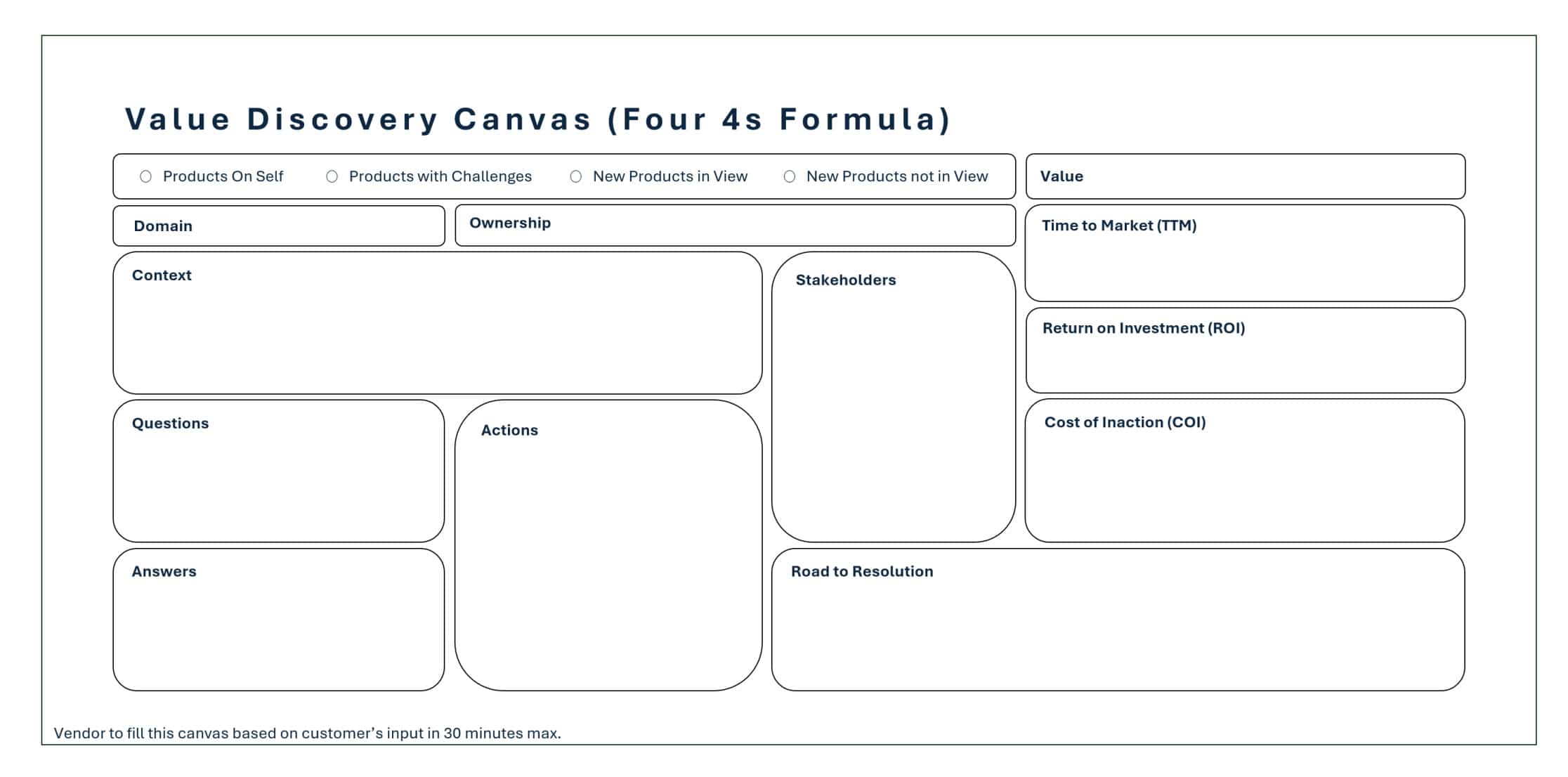
Ideally to fill this canvas based on input in 30 Minutes max.
Opportunity Evaluation & Scoring Sheet
The Opportunity Evaluation & Scoring Sheet provides a structured and objective way to assess, compare, and prioritize Data & AI opportunities before committing significant investment. It translates early-stage discussions into measurable criteria by evaluating strategic alignment, business value, user impact, delivery feasibility, risk, and governance readiness.
By applying consistent scoring across these dimensions, organizations can move beyond intuition-driven decisions, create transparency in prioritization, and focus resources on opportunities with the highest likelihood of delivering meaningful business impact. This approach enables leadership teams to make informed, defensible decisions while ensuring alignment between strategy, execution, and value realization.
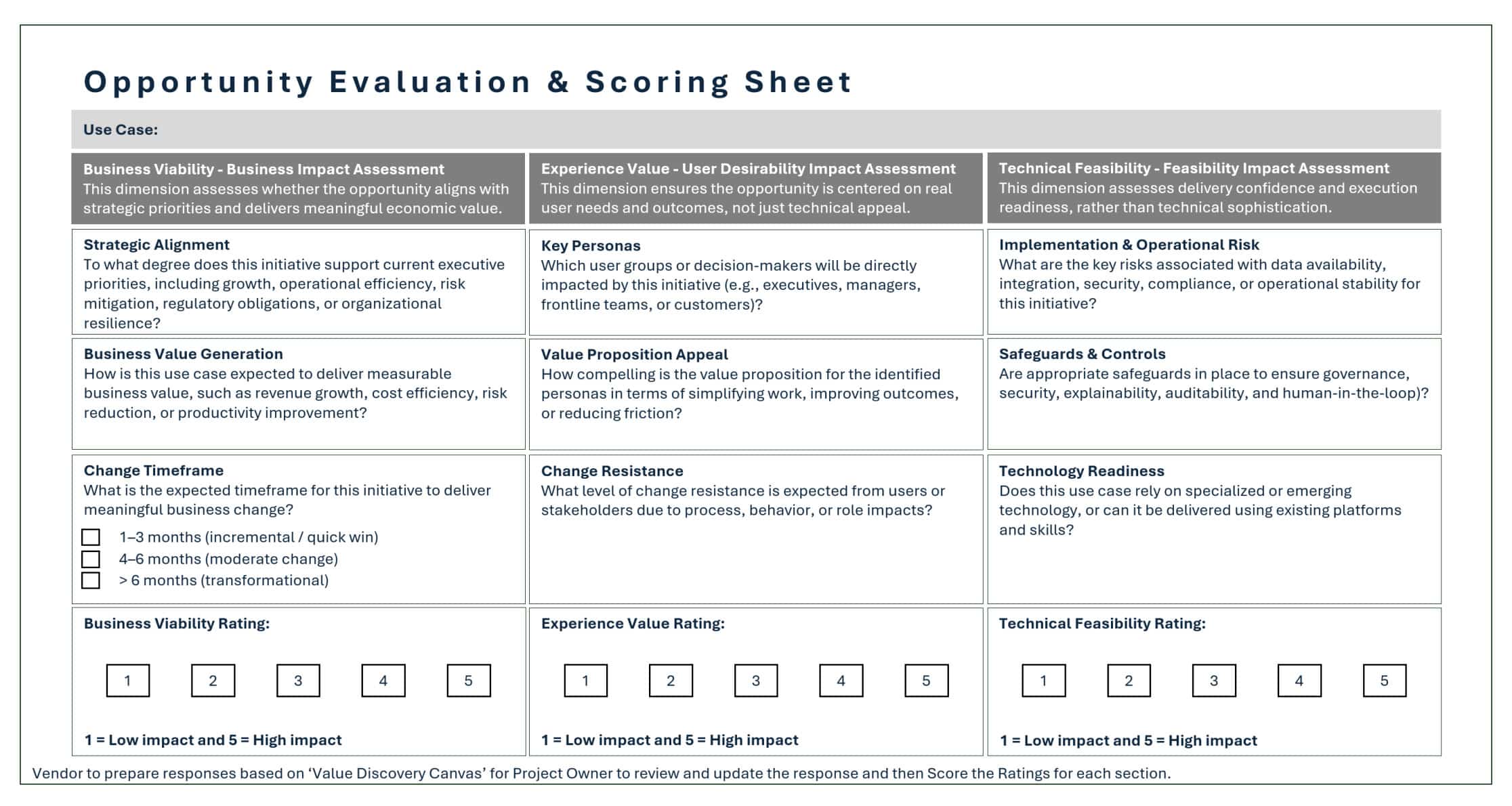
Business Viability
- Strategic Alignment: Does the initiative support current executive priorities?
- Business Value Generators: Expected measurable business value
- Change Timeframe: Expected timeframe to deliver meaningful change
Rating: 1-5 (1 = Low Impact, 5 = High Impact)
Experience Value
- Key Personas: User groups impacted by this initiative
- Value Proposition Appeal: Compelling value proposition for identified personas
- Change Resistance: Level of change tolerance expected
Rating: 1-5 (1 = Low Impact, 5 = High Impact)
Technical Feasibility
- Implementation & Operational Risk: Key risks associated with delivery
- Safeguards & Controls: Appropriate safeguards for governance
- Technology Readiness: Can it be delivered using existing platforms?
Rating: 1-5 (1 = Low Impact, 5 = High Impact)
Use Case
The Use Case step provides a structured way to capture and evaluate Data & AI use cases by grounding them in real business needs and accountable ownership. Each use case is defined by the problem it aims to solve, the proposed idea or approach, and the specific business objective that defines success.
It further clarifies which KPIs and measurable outputs will be influenced, ensuring progress and impact can be tracked objectively. By explicitly identifying the accountable business stakeholder responsible for outcomes, this approach enables clear ownership, informed prioritization, and confident decision-making on which initiatives should move forward.
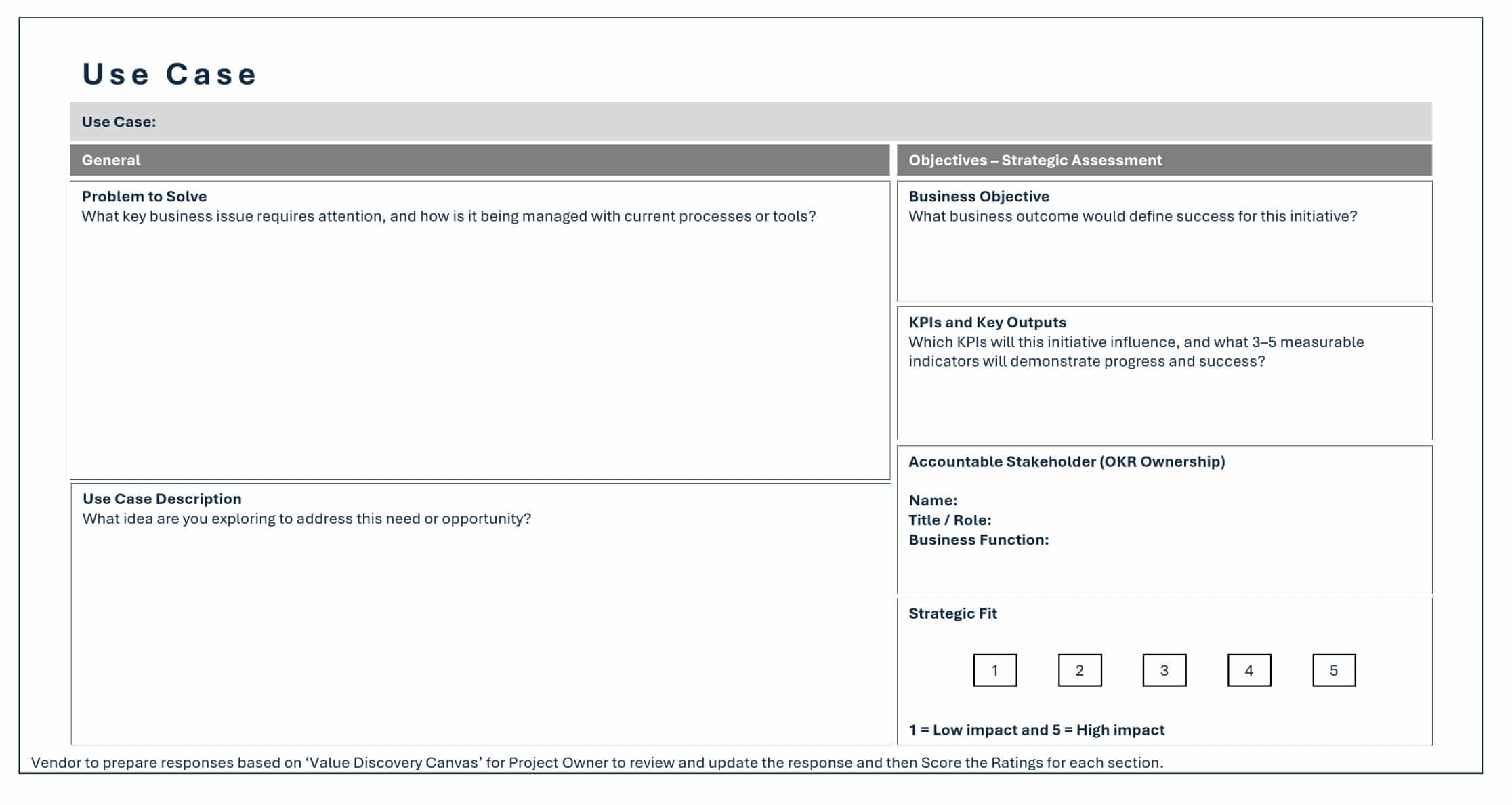
Problem to Solve
What key business issue requires attention, and how is it being managed with current processes or tools?
Business Objective
What business outcome would define success for this initiative?
KPIs and Key Outputs
Which KPIs will this initiative influence, and what 3-5 measurable indicators will demonstrate progress and success?
Accountable Stakeholder
Name, Title/Role, Business Function - OKR Ownership
Use Case Prioritization Chart
The Use Case Prioritization Chart provides a visual and comparative view of Data & AI use cases to support clear, outcome-driven decision-making. By mapping initiatives based on their relative business impact and feasibility, the chart helps leadership teams distinguish between high-priority opportunities, quick wins, exploratory initiatives, and lower-priority candidates. This visual approach enables transparent trade-off discussions, aligns stakeholders on sequencing and investment focus, and ensures resources are directed toward use cases with the greatest potential to deliver measurable business value in a timely and manageable way.
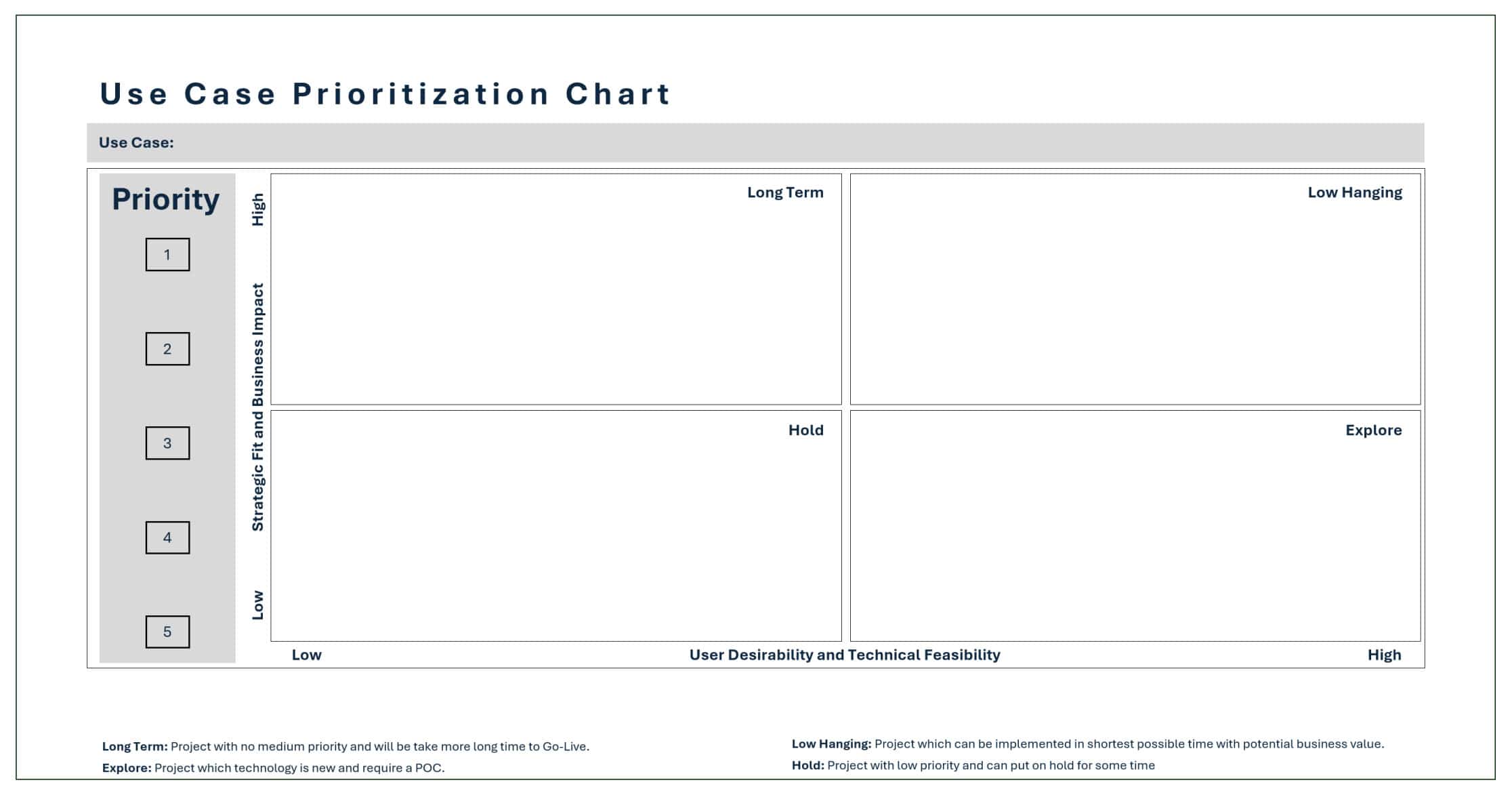
Long Term
High Business Impact + Low Feasibility: Projects with no immediate priority and will take more long-term to the Line.
Low Hanging
High Business Impact + High Feasibility: Projects which can be implemented in shortest possible time with potential business value.
Hold
Low Business Impact + Low Feasibility: Projects with low priority and can be put on hold for some time.
Explore
Low Business Impact + High Feasibility: Projects which are technology or use and require a POC.
How to Apply the Four 4s Formula
There are three structured ways to adopt and apply the Four 4s Formula, depending on the level of involvement and support required.
Executive Introduction
30 Minutes
For leaders who want a high-level understanding of how the Four 4s Formula – Value Discovery Canvas works in practice, a 30-minute introductory session is available. This session provides a concise walkthrough of the canvas and explains how it is used to structure value-led Data & AI conversations at an executive level.
Request SessionGuided Executive Value Application
2 × 90 Minutes
For organizations that want to apply the Four 4s Formula – Value Discovery Canvas using their own internal teams, a structured, paid engagement is available, delivered across two 90-minute facilitated sessions. These sessions guide participants through the complete canvas in detail, systematically evaluating sampled Data & AI initiatives while ensuring disciplined problem framing, decision clarity, clear ownership, and value alignment — without outsourcing ownership or execution.
Get StartedCanvas-as-a-Service
Professional Services Engagement
For organizations that prefer to outsource the application of the Four 4s Formula – Value Discovery Canvas, a separate professional services engagement can be established. Under this model, our team works directly with business stakeholders to facilitate structured interviews, synthesize inputs, and produce a decision-ready, value-led canvas that leadership can confidently act upon.
Contact Us"Move from framework awareness to decision clarity, and from clarity to value."
Ready to Apply the Four 4s Formula?
Transform how your organization discovers, prioritizes, and delivers Data & AI value.