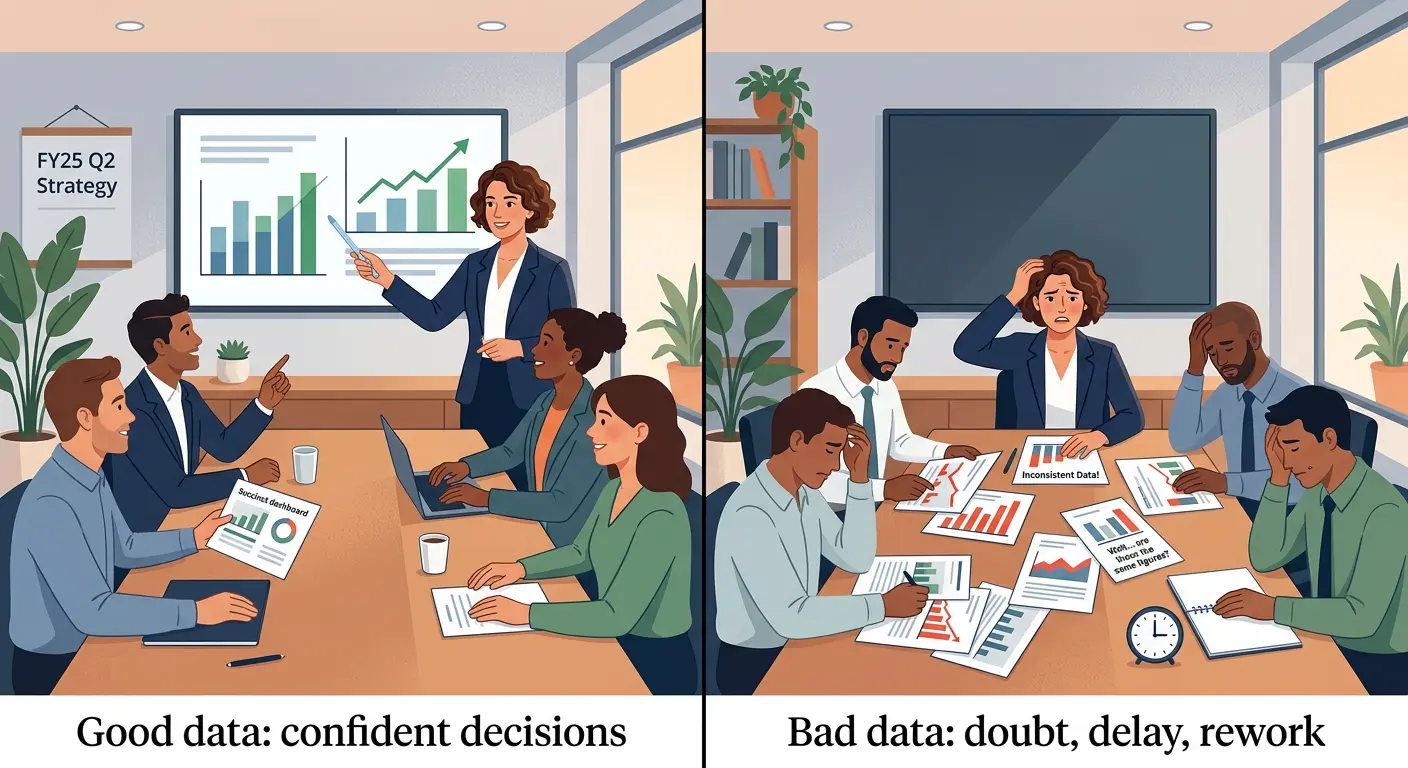
Data is only as valuable as its quality. An organisation can operate a state-of-the-art analytics platform and still make catastrophically wrong decisions if the data feeding those decisions is inaccurate, incomplete, or inconsistent. Data quality is not a technical concern delegated to IT. It is a business risk that demands strategic advisory attention at the leadership level.
The Business Cost of Poor Data Quality
Poor data quality is not an abstract problem. It has measurable, concrete consequences across every business function:
- Financial impact: Incorrect billing, failed deliveries, and duplicate payments drain revenue and inflate operational costs.
- Regulatory exposure: Inaccurate data can lead to compliance violations and regulatory fines, particularly in financial services, healthcare, and public sector organisations.
- Operational inefficiency: Studies consistently show that knowledge workers spend 20-30% of their time finding and correcting bad data, time that produces zero business value.
- Strategic misdirection: Decisions based on flawed data lead organisations in the wrong direction, from product launches to market entry strategies.
- Damaged trust: When stakeholders, customers, or regulators discover data errors, confidence erodes quickly and is difficult to rebuild.
The 8 Dimensions of Data Quality
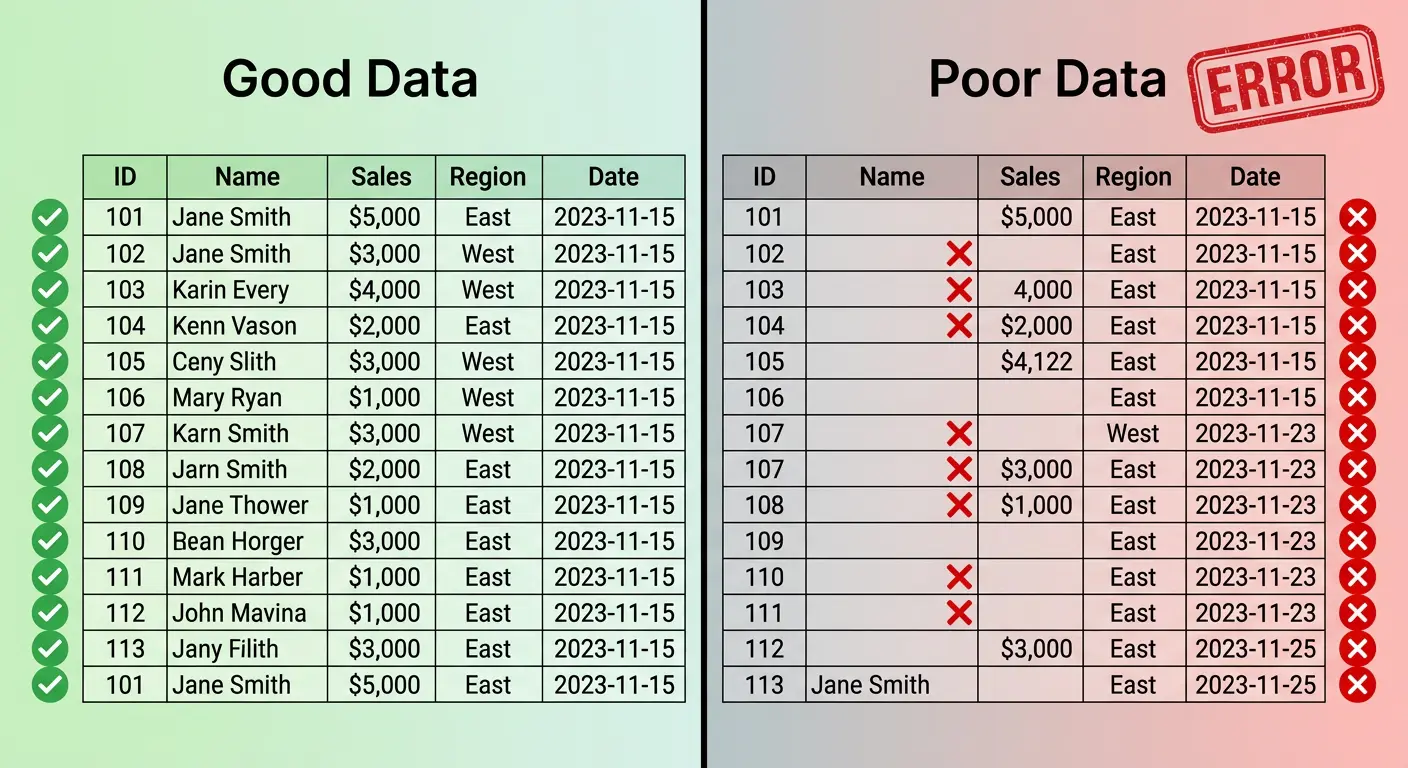
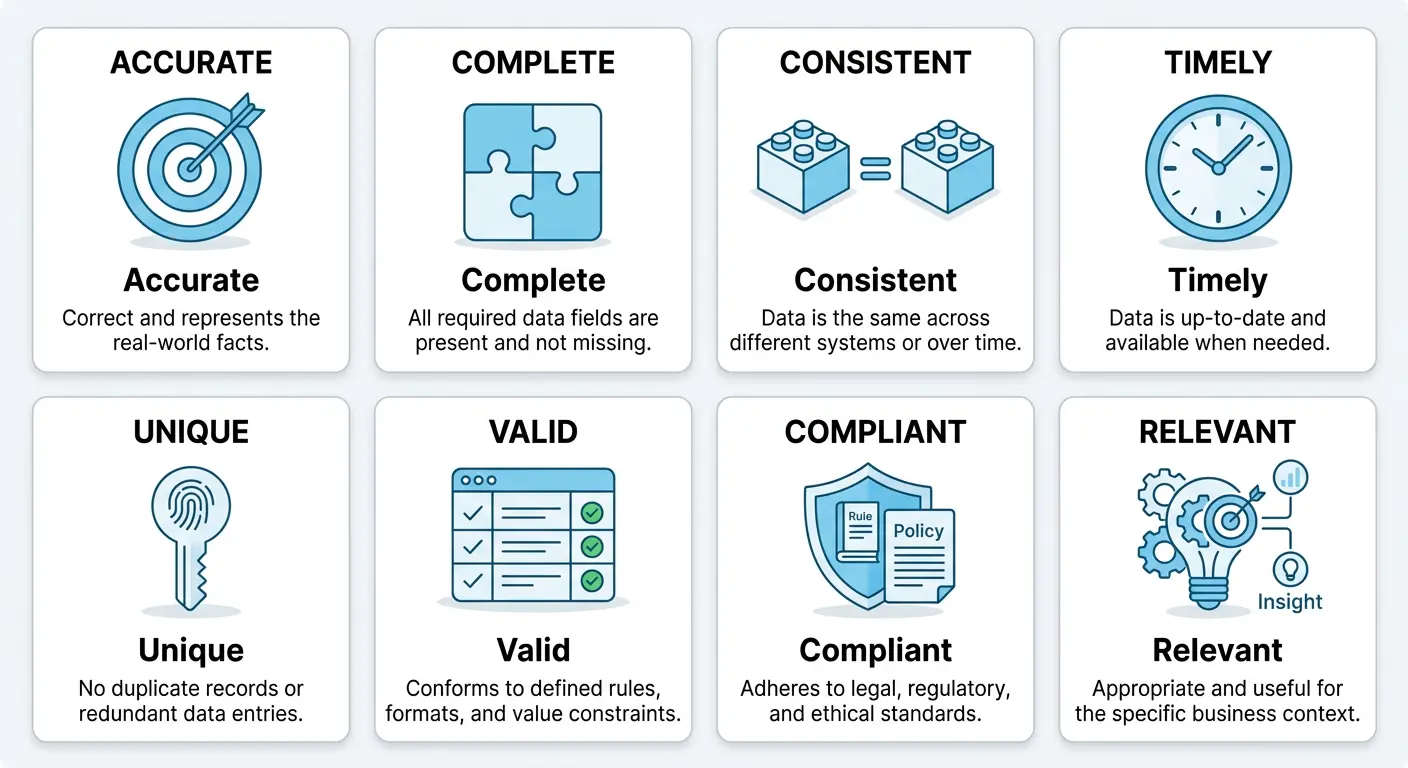
Data quality is not a single attribute. It is a composite of eight distinct dimensions. Each dimension must be actively measured, monitored, and managed.
| Quality Dimension | Definition | Failure Symptom |
|---|---|---|
| Accurate | Correctly reflects reality | Wrong addresses, incorrect figures |
| Complete | All required fields present | Missing contact details, null values |
| Consistent | Same values across systems | “UK” vs “United Kingdom” |
| Relevant | Serves its intended purpose | Unused stored data consuming resources |
| Timely | Current and recent | Reporting on outdated data |
| Reliable | Trustworthy collection methods | Biased surveys, flawed sensors |
| Valid | Conforms to defined rules | Dates entered as free text |
| Accessible | Available to authorised users | Siloed systems, locked-down data |
Real-World Examples: Good Data in Practice
When organisations invest in data quality, the results are tangible and measurable:
- Accurate customer addresses (logistics): A delivery company with validated, geocoded addresses achieves near-zero failed deliveries, reducing costs and improving customer satisfaction.
- Complete financial records (audit): Organisations with complete, gap-free financial records pass audits faster, with fewer findings and lower compliance costs.
- Consistent product catalogue (retail): A retailer with a single, consistent product master across all channels avoids pricing conflicts, stock discrepancies, and customer confusion.
- Timely market data (financial services): Trading desks that receive real-time, up-to-date market data make better-informed decisions and manage risk more effectively.
- Validated medical records (healthcare): Hospitals with validated patient data reduce medication errors, duplicate records, and misdiagnoses, directly improving patient outcomes.
Real-World Examples: Bad Data in Practice
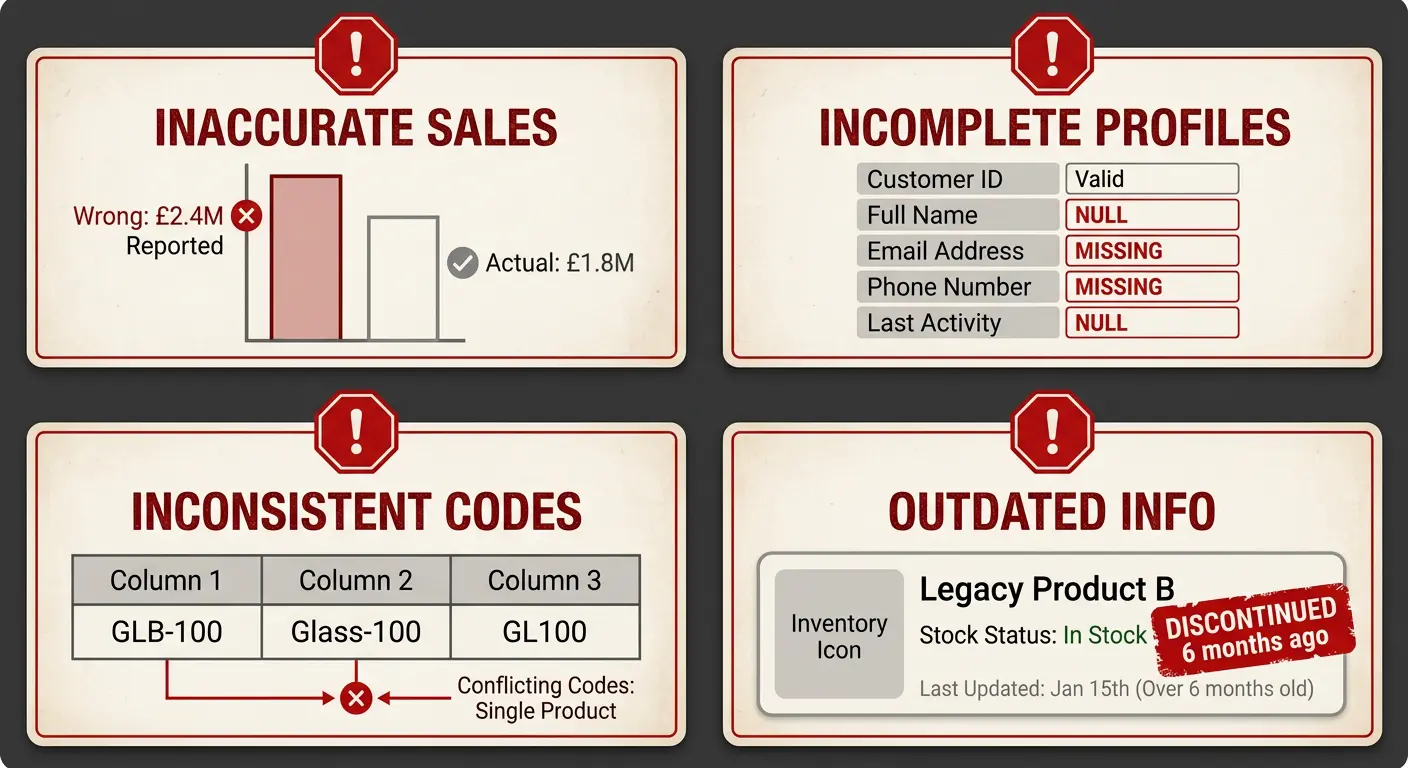
The consequences of poor data quality are equally concrete:
- Inaccurate sales figures (CRM): A CRM system with duplicated or incorrectly attributed sales data inflates pipeline reports, misleads leadership, and distorts forecasting.
- Incomplete customer profiles: Marketing teams working with incomplete customer data waste budget on untargeted campaigns and miss high-value segments entirely.
- Inconsistent inventory records: When warehouse systems and e-commerce platforms disagree on stock levels, the result is overselling, stockouts, and operational chaos.
- Outdated product information: Product listings with stale pricing, discontinued items, or incorrect specifications erode customer trust and increase return rates.
A Data Quality Management Framework
Sustained data quality requires a structured management framework, not a one-time cleanup project. The five pillars of an effective data quality programme are:
- Data Profiling: Systematically assess the current state of your data. Identify anomalies, gaps, and patterns before applying fixes. Profiling answers the question: How bad is it, and where?
- Validation Rules at Entry: Prevent bad data from entering your systems in the first place. Implement format validation, mandatory fields, and business rule checks at every data entry point.
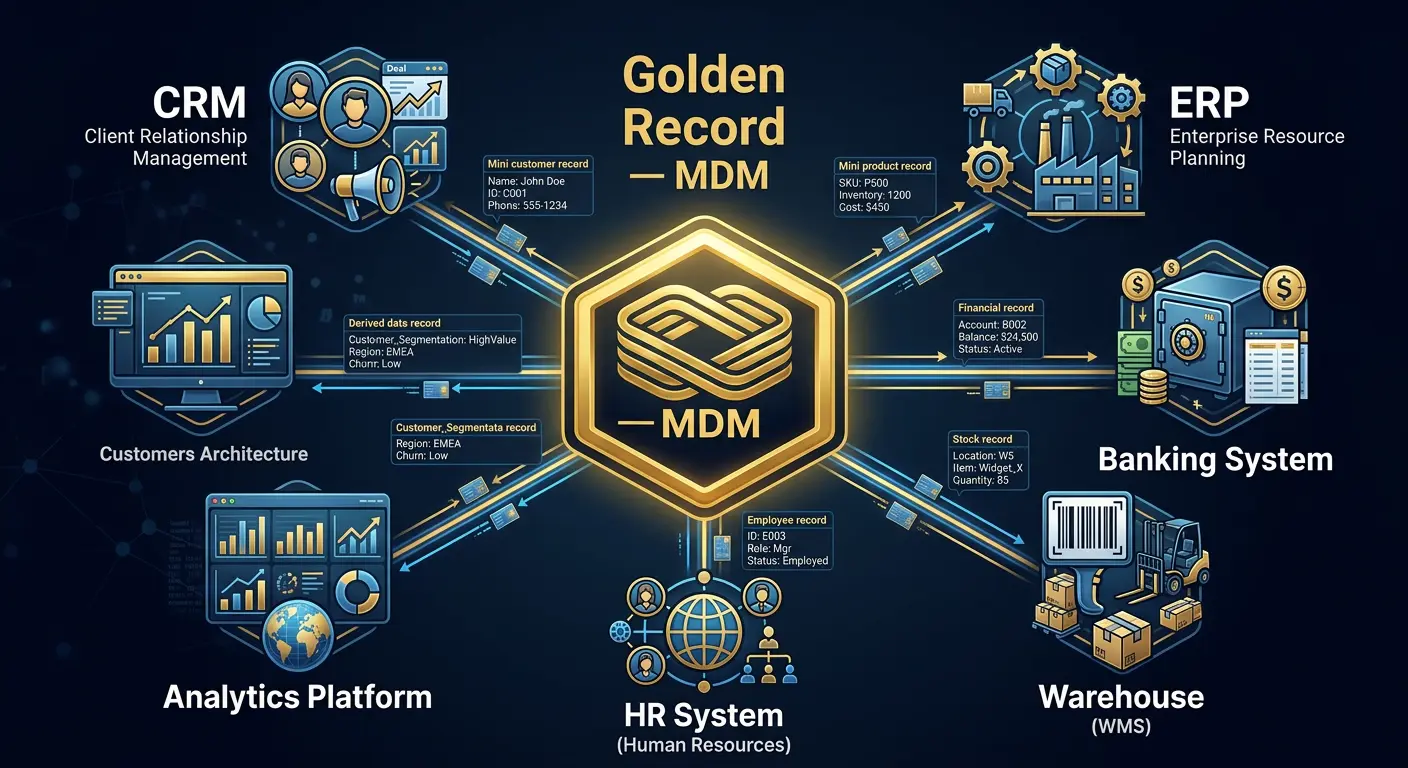
- Master Data Management (MDM): Establish a single, authoritative source for core entities, including customers, products, and suppliers, that all systems reference. MDM eliminates the “which system is correct?” problem.
- Data Stewardship: Assign human accountability for data quality within each business domain. Data stewards are the people responsible for defining, monitoring, and enforcing quality standards.
- Data Lineage: Track where data originates, how it transforms, and where it flows. When issues arise, lineage makes root cause analysis possible rather than guesswork.
- Professional Development: Equip your team with the skills to manage quality through certified data management training programmes.
Good data quality is not aspirational. It is an operational requirement. Across all eight dimensions, every organisation needs a defined standard and the governance programme to maintain it. In data, garbage in = garbage out. The inverse is equally true: quality in = quality decisions out.

Ready to build a data quality framework that lasts?
Your Partner Technologies builds data quality frameworks, MDM programmes, and governance structures that make data a trustworthy asset.
Talk to Us →